
Wednesday, March 9, 2011

Guest post: When the minority is the majority on stage


Mu will soon be opening Little Shop of Horrors, a classic American musical loosely based on the 1960 film. Clearly, it’s a popular, beloved, iconic musical complete with cranky Jewish shopkeeper, blonde bombshell, nebbishy hero with a heart of gold, and trio of African-American women paying homage to the girl groups of the 1960s.

And now a bunch of Asian-Americans are producing it. Perhaps it will be weird at first to some people. Some may continue to think it’s weird even after seeing the show. (You are coming to see the show, right? Excellent!) However, I feel that if we do our job well, it won’t seem weird at all.


Let me backtrack for a moment. My name is Sara. I’m a Korean-American adoptee who spent the majority of the last five years living in Seoul, South Korea. It was a fascinating experience on many levels. One of the more intriguing was that for the first time in my life, I felt what it is like to be part of a racial majority. It ROCKED. I wish minorities of any kind could step into the shoes of their opposing majority and truly experience life from that point of view, and the same for majorities of any kind. It does really cool things to your perspective.


As a result, for me, having an all-Asian cast performing a classic from the American musical cannon seems. . . normal. The productions I saw in Seoul usually had an all-Asian cast. I saw all-Asian casts of Puccini's Madame Butterfly (fascinating!), Billy Elliot, an amazing adaptation of Macbeth, and a rehearsal of Rebecca Gilman’s Dollhouse.


Musical theater especially has been hugely popular in South Korea over the last five years. There are currently all-Asian productions of Billy Elliot, Aida, and Monte Cristo, among many others, playing throughout the city. Hedwig and the Angry Inch has been so popular since its debut in Korea in 2005 that nearly every famous Korean musical actor or rock star has played the title role.


I am by no means an expert on Korean society or non-traditional casting practices around the world, but I have the impression that to the average South Korean, it's not weird to see another South Korean playing a character of Caucasian or other ethnicity in a show. From my experience, attempts to justify the casting of all-Asians in a Western production by changing the setting, for example, typically aren’t made. It’s usually all Asians, all the time; that’s just the norm.


For me, seeing Asians playing Caucasian, African, or mixed-race Americans or Europeans was fascinating for a few moments, but if the performances were done well, I soon got lost in the world of the play. Afterwards, I would sit down with friends and discuss the show. What was amazing? What was distracting? Who was drool-inducingly hot? How did the casting affect our experience? There are Caucasian and other non-Asian actors in Seoul, so why weren’t they cast?


South Korea is much different from our American standards of racial sensitivity. It’s true that the country doesn’t have the history, context, or experience to understand how offensive certain actions, such as blackface, are to other cultures. With these considerations in mind, the decision of a South Korean director to use non-traditional casting is, clearly, much different from that of an American director making a similar choice. Perhaps race is simply a non-issue during the casting process. I don’t know.


What I do know, as I slowly sort through everything I’ve learned from life overseas, is that the United States is an incredibly unique country. We Americans have such a complex history of racial, gender, and sexual struggles for equality and independence that we have the opportunity – the luxury, even – to speak with a shared vocabulary. Our uniquely American need to define and categorize our identities causes discussions to occur, theoretically leading to in-depth conversations about race and identity where everyone has the potential to learn and understand.


Sadly, this should be neither amazing nor unique in the world, but at least in my experience, it is. I often attempted to explain why blackface was racist or tried to define racism with my friends and students in South Korea, only to meet puzzled, polite faces. Much of this was due, of course, to our lack of shared language skills. I have acquaintances from Europe who have to converse about race in English, their second or third or even fourth language, because their first language doesn't have a vocabulary to talk about racial issues. Can you imagine that? It’s lead to a lot of heartache for many European Korean-adoptees, but that’s a topic for another time.


Will it be weird for you, our most excellent audience, to see an all-Asian cast performing Little Shop of Horrors? Initially, perhaps it will. However, hopefully as you fall into the world of this fabulous show, you’ll forget that you’re seeing Asian-Americans. You’ll see the characters in all of their quirky, beautiful lives. You’ll laugh and cry and have an all-around great time with our immensely talented Asian and Caucasian American cast, crew, and creative team. And afterwards, perhaps you’ll reflect on the experience and think a little differently about this incredible, one-of-a-kind, racially diverse country we all share.


And if that happens, then I, personally, will feel we’ve done our job well.


by Sara Ochs

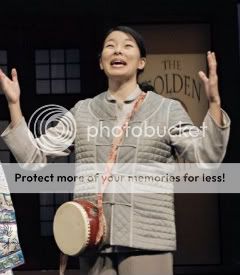
Photo: Sara Ochs in Mu's production of Flower Drum Song, (c) Michal Daniel 2009

Sunday, March 6, 2011

Can Thia Megia erase the memory of William Hung?


I'm not yet ready to place Thia Megia in the ranks of Gary Locke, Connie Chung, Michael Chang and other trailblazing Asian Americans.
But the 16-year-old's accession last week to American Idol finalist is quite impressive, a victory that puts her within striking distance of instant pop culture relevance.
Say what you want about American Idol's fading popularity but should Megia ultimately triumph, she could be the first recognizable Asian American pop music star...well, at least for her first album. (Sorry folks, Norah Jones doesn't count- hardly anyone knows she's part Asian. Her music is also more adult contemporary than pop.)
But more importantly, Megia can finally give American Idol audiences an Asian American to think about other than William Hung.
With his thick accent, sexless demeanor, and off key warbling, Hung has done more damage to Asian American heritage than the Chinese Exclusion Act and Japanese interment camps combined.
Not just because he sucks, but because Hung symbolizes every negative stereotype about Asian men. Worse yet, Hung has openly exploited his infamy, the modern day star of yellow face minstrel shows. I'm still not sure whether Hung knows he's the butt of jokes or if he even cares.
That either makes him the world's greatest idiot or the world's shrewdest capitalist.
Megia, on the other hand, is the complete anti-Hung. The former NBC America's Got Talent contestant has plenty of that. Her semi-final rendition of "Out Here On My Own" was technically superb.
Megia's youth also serves her well. From past champ Jordin Sparks to former runner-up David Archuleta, American Idol fans have embraced teenagers with fresh, pretty faces who sing beyond their years.
Will Megia actually win? Judging from American Idol's recent history, I'd say no. Since Sparks' triumph in Season 7, the American public have chosen three relatively dull white guys. (Can anyone really tell the difference between Kris Allen and Lee DeWyze?)
But having made the Top 10, Megia has secured a spot in the American Idol road tour and probably a recording contract of some kind. Unfortunately, unless Megia wins or finishes second, we'll probably never fully wipe clean the nightmare that's William Hung.

Thursday, March 3, 2011

We DO all look alike


Way to represent!

Take a good look at the world's most typical face, at least according to National Geographic. The image is actually a composite of 7,000 photographs of a 28-year-old Chinese man of Han descent.

Surprised? You shouldn't be. China, after all, is home to 1.4 billion people (the majority belong to the Han ethnic group), which represents about 20 percent of the world's population. Of the world's 7 billion people, there are 9 million 28-year-old Han Chinese men.

That face will change in about 30 years. With an estimated population of 1.5 billion, India's population will surprise China by 2040.

Wednesday, March 2, 2011

A "Tiger" awakens in writer/journalist Cheryl Tan


Most mid-career adults facing a professional and personal crisis would see a therapist or perhaps buy a motorcycle.


Cheryl Lu-Lien Tan wrote a book about food and family. The former newspaper reporter’s memoir, A Tiger in the Kitchen, has earned excellent reviews and is rapidly climbing the charts on Amazon.com.


Kirkus Reviews called “Tiger a recipe in itself—a dash of conjuring the ancient stories of one's past, a sprinkling of culinary narrative. The result is a literary treat filled with Singaporean tradition, including the surprisingly significant role food plays in the Festival of the Hungry Ghosts and the Moon Festival, among others.”

Born in Singapore but a long time resident of the United States, Tan unspools the thread of her life through the most universal of human experiences: cooking and eating.


You wrote Tiger after your parents got divorced and the Wall Street Journal cut your job. How did those events influence your desire to write the book?

When the earth moves under your feet all of a sudden, it does make you take stock of your life and your state of happiness. Looking back, though, I think I've always had this book in the back of my head. It took many years of being away from Singapore, from home, from my family to miss it all (and the food) to the extent that it nudged me to take a year off to travel back to discover the recipes, the dishes and the important people of my childhood.

Tiger seems like an attempt to reconnect with your roots in Singapore. Did you feel you had become "too American?"

In many ways, I was very westernized as a child -- I grew up not knowing how to speak Teochew, the Chinese dialect that my family speaks, and not really knowing a lot about my heritage. Like many Singaporeans of my generation, I was raised on McDonald's as well as Singaporean dishes like chicken rice and chili crab. It wasn't until I was actually in America for many years that I felt a yearning for a lot of the foods I grew up loving and taking for granted. It was lovely to have a year to reconnect with it all.

You draw a strong relationship between food and family. But does that relationship necessarily apply to modern American society, where people eat on the go and the idea of a traditional sit down family meal seems almost quaint?

Even though many American families don't often have the time to have sit-down family dinners, I think many have fond memories of dishes that they grew up loving -- when I first wrote about going home to learn how to make my late grandmother's pineapple tarts for the Wall Street Journal, I got emails from readers -- many of them not Asian -- who all had a dish that the story reminded them of. One reader talked about her grandmother's sugar cookies; another mentioned her father's sloppy joes -- all of them expressed a deep regret that they had not taken the time to learn how to make them. I think that's something universal -- so many of us are so busy these days we don't often have the time or think to make the time to sit down with our family members to learn how to make these dishes that have defined us. It's a pity.

Reviewers have compared your book to everything from Women Warrior and Julia and Julia to Battle Hymn of the Tiger Mother. How do you feel about that?

It has been very humbling for me -- I read the Woman Warrior as a teenager and was in complete awe of Maxine Hong Kingston. To be compared to her in any small way -- that really blew me away. I couldn't believe it. And I adored Julie Powell's book when I read it -- it's certainly been a wild ride.


Any thoughts of turning Tiger into a movie or a play? If so, who would play you and your family?

I haven't thought that far ahead! I do love Maggie Q in Nikita-- I understand that she spent some time in Asia and knows Singapore. I hope she reads the book and likes it!

Sunday, February 27, 2011

Anchors Away? 14th Amendment Under Attack


Among my most prized possessions in my rather cluttered apartment is a fraying, green document that declares that Thomas Ding-Moon Lee was born on December 12, 1977 in Boston, Massachusetts, 10:41 a.m. to be precise.


I probably value my birth certificate more than the average Joe because it proves that I am, indeed, a citizen of the United States of the America. Since I’m second generation Chinese, born to immigrant parents, I can’t really take anything for granted.


Am I little paranoid? Maybe. But given the ugly debate over immigration in recent years, better safe than sorry.


The latest example is the effort by some lawmakers in Congress and state capitals to deny citizenship to so-called “anchor babies,” the children born to undocumented workers in America.


You would think that we settled this a long time ago. The Fourteenth Amendment, passed in 1868, states: “All persons born or naturalized in the United States, and subject to the jurisdiction thereof, are citizens of the United States and of the State wherein they reside.”


But these days, nothing seems set in stone, even Constitutional clauses and established case law.


Including this one: in 1894, American-born Wong Kim Ark sailed to China for a temporary visit. When Ark attempted to return to San Francisco, immigration authorities denied him entry, arguing Ark was not a citizen because his parents were subjects to the Emperor of China.


Officials were enforcing the Chinese Exclusion Act, passed 12 years earlier, that attempted to limit the number of Chinese immigrants in the country.


In a 6-2 decision, the U.S. Supreme Court ruled in favor of Ark, reaffirming the citizenship clause of the Fourteenth Amendment.


Of course, history has proven that citizenship on paper doesn’t necessarily mean you’re a citizen in practice. It took more than a hundred years for blacks to realistically exercise the rights granted to them by the Fourteenth Amendment.


After the Japan’s attack on Pearl Harbor in 1941, the federal government herded Japanese people, citizen or not, to internment camps in the southwest.


But history and law aside, it’s today’s venomous climate that makes me queasy. Targeting adult undocumented workers is one thing. But to target new born babies, who really didn’t have any say in the matter, just seems cruel and mean spirited.


And if we undermine the citizenship clause of the Fourteenth Amendment, where does it end? What could prevent lawmakers from retroactively denying citizenship to people whose crime was being born in the United States to immigrants, documented or not?


Somewhere, Wong Kim Ark is spinning in his grave.

Wednesday, January 12, 2011

A Truly Global Billy Elliott

As the house lights fell on the Orpheum Theater in Minneapolis Friday night, a booming voice announced that Lex Ishimoto would play the lead role of Billy Elliot.

Lex Ishimoto?

Moments later, a skinny boy with black hair and diamond shaped eyes wandered onto the stage sporting a thick brogue and Baryshnikov-like dancing skills.

Based on the movie, Billy Elliot: The Musical is the story of an 11-year-old boy in working class Northern England who longs to be a ballet dancer, much to the consternation of his miner father and older brother.

The producers of this national tour have employed the services of five young actors to rotate the role of Billy. Given the physical demands of the role, that’s not entirely surprising. What‘s surprising are the names of the five actors: Giuseppe Bausilio, Michael Dameski, Kylend Hetherington, Daniel Russell, and Ishimoto.

Ishimoto, a Japanese American from California, would seem like an odd choice to play Billy. It also begs the question: shouldn’t have the producers cast a white actor to play the very white role of Billy Elliot?

Last year, the board of Mu Performing Arts objected to the Minneapolis Children’s Theater casting a white actor in a key Asian role in its production of Mulan.

So why it is okay to cast an Asian American kid as a white English boy and not a white actor as a Chinese general?

It’s a difficult question and in some ways cuts to the very heart of affirmative action in the United States.

Opponents of affirmative action say the policy is little more than reverse discrimination. In a truly race-blind society, merit, not skin color, should be the ultimate factor. After all, didn’t Dr. Martin Luther King Jr. have a dream that one day society will judge people not on the color of their skin but the content of their character?

The problem with that argument is that day has not yet arrived…and may never will. Dr. King was speaking of a dream, not of an inevitable outcome. We may never realize that dream but we certainly must try.

In theater, the question is not just about culturally correct casting. It’s about opportunity. The vast majority of actors working in Broadway and national theater are white as is the material they are playing.

While it’s all good to say that a worthy actor can play any role, the sad reality is that you’re more likely to see a white actor portray Hamlet on Broadway or the Guthrie than an Asian American.

Yes, there are more Asian American actors, directors, and playwrights working in theater today. But it’s unlikely their work will boast the commercial appeal of The Phantom of the Opera or Les Miserables.

(Quick…name a smash hit Asian American-penned musical. That’s what I thought.)

So when a role like the general in Mulan or Song Liling in M. Butterfly comes along, you better believe deserving Asian Americans will want those opportunities.

Does casting Ishimoto as Billy Elliot detract from the role? Maybe it’s a little distracting in the beginning. But as the musical progresses and you see the breadth of Ishimoto’s amazing talent, you start to care less and less.

Did the producers need to cast Ishimoto? No. But I’m glad they did.

In fact, Ishimoto’s background enhances the material. Where else in the world can a skinny Japanese American kid from California wow audiences on a national tour of a smash hit British musical?

Billy Elliot is a show about a kid that seizes a wonderful opportunity despite his background through hard work and talent. It could easily be the story of Lex Ishimoto.

But Billy’s story is the exception, not the rule. While Billy wins an invitation to the Royal Ballet school in London, the rest of his hardscrabble town must cope with broken lives and decaying mines.

“We can’t all be dancers Billy,” Tony tells his younger brother.

I guess that’s why Billy Elliot is a work of fiction, a dream of sorts.

But what a dream.


photo via broadwayworld.com
entry by Thomas Lee

Thursday, December 23, 2010

The Meaning and Message of Taiko

A recent New York Times article described a passionate debate stirring up the yoga community. According to the Hindu American Foundation's position paper, many yoga practitioners are either ignorant of or work actively to decouple yoga and its Hindu base. The Foundation's campaign, "Take Back Yoga," asks that practitioners acknowledge the religion and culture from which it was birthed while also asserting that yoga's benefits are for all. This request provoked reactions from diverse ends of the spectrum including New Age guru Deepak Chopra and R. Albert Mohler, Jr., president of the Southern Baptist Theological Seminary.

As a yoga practioner, I admit freely that I've little knowledge of yoga and Hinduism while receiving so much: centeredness, focus, not to mention a workout that keeps me limber and flexible. I have, however, often asked myself what Indian Americans think of this wholesale, very American co-opting of this part of their heritage. Would a base knowledge help my yoga practice? Of course! It could only help enrich my understanding of the religion from which it came.

I've been wrestling with similar issues for taiko and Mu Daiko, especially as we work towards realizing our mission of "great performances born of arts, equality and justice from the heart of the Asian American experience." I have so many questions and few answers. The New York Times articles ask, "Who owns yoga?" I could ask, "Who owns taiko?"

There are about 200 North American taiko groups. Some approach taiko as an international music form to be shared with and performed by all. Others will cite taiko as an expression of community-building within Japanese/Japanese American/Asian American culture. Some groups are specific outgrowths of Japanese Buddhist churches and many more will cite some combination of the above. The ethnic and racial compositions of these groups vary from those predominately Japanese/Japanese American/Asian American (West Coast and Hawaii) to those with little or no such representation.

Mu Daiko is based on San Francisco Taiko Dojo's philosophies through Rick Shiomi's direct study with Seiichi Tanaka. Another influence, in a less overt way, was Rick's work as a community organizer in Vancouver's Japanese/Asian Canadian neighborhoods. His co-founding of Katari Taiko (Vancouver) and Wasabi Taiko (Toronto) in addition to Theater Mu was a direct response to the need for Asian American artists to have a voice. It was a handful of Mu's Asian American actors who begged Rick to teach them taiko.

At its inception (1997), Mu Daiko was comprised solely of Asian Americans (Japanese Canadian, Japanese American, Korean American, Filipino American, Indian American) and over the years has maintained (without conscious thought) a 50-80% Asian American presence. This percentage includes those of multicultural heritage who identify as Asian American. Mu Daiko audiences are largely non-Asian and draws its performers from the ranks of its students. Currently, 95% of our students are non-Asian. In the very near future, we could be looking at a majority non-Asian presence within Mu Daiko.

Why do we play taiko? Professionals and students alike say they love the sound of the drums, the movement, the great workout and taiko's cathartic nature. A few will say they're interested in Japan, and with the exception of a handful of Asian American students, almost no one will say that taiko is a way to connect with Asian American culture. Like yoga, it appears to be the outside trappings of the art form that are so attractive and compelling. I can't fault any of these reasons--they are certainly part of why I choose to keep learning and performing and composing. But I also play to connect with my Japanese heritage and to be a part of the local Asian American community. Is it possible for Mu Daiko to fulfill its mission through non-Asian taiko artists? Can a non-Asian create work "from the heart of the Asian American experience?"

Like so many other musicians/artists, I want to create and perform with the very best folks around. And, without doubt, we give best service to any art form by finding these best artists. But as with yoga, I also believe that taiko's cultural essence is integral to the art form. However, it comes to manifest itself in the process--through Asian American artists, or through non-Asians willing to immerse themselves in the history and culture--enriches us all.

In order for Mu Daiko to fulfill its mission, we will continue to recruit potential artists from the best students available, regardless of race or gender. We will especially encourage talented Asian American students. Regardless, each player will be expected to share taiko through his/her own Asian American lens or to be a knowledgeable culture bearer, an ally willing to transmit a sense of the "heart of the Asian American experience."

by Iris Shiraishi