
Showing posts with label theater productions. Show all posts

Wednesday, March 16, 2011

Guest post: When the gods want to punish us, they answer our prayers.

A reflection on Little Shop of Horrors from one of the show's stars.


I was famous once.

No, seriously, I was. During my study abroad trip to China, I performed in the University's talent show. Little did I know, talent shows are a huge deal in China.

The other kids in my study abroad group and I frequented this one hole-in-the-wall noodle stand on campus. Around lunchtime the tables would fill up with students. After the talent show, the proprietor started bringing me from table to table. He’d say something in Chinese, the students would laugh, say hello and wave at me, and we'd be on to the next table. One day, he was able to eek out the words "English Student" during one of our table stops so I asked, "why does he keep doing this?"

"Everybody knows you eat lunch here."

Everybody? Who's everybody? Next thing I knew, strangers who barely spoke English knew me by name and were saying hello to me on the street. I was signing autographs, I was being asked to spend whole afternoons posing for pictures in front of different landmarks around campus with groups of strangers. No joke: whole afternoons. It had become the kind of thing that everyone in my study abroad group had an, "I had to leave Pogi at such-and-such-place to take pictures with some randoms," story.

Growing up, I often wondered what it would be like if I were rich and famous. Now here I was, in a city where you could get a good meal for about 12 American cents, and my mere presence sitting at the tables outside the restaurant was apparently doing wonders for the aging restaurant owner’s business. And what I learned, during my (albeit brief) bout of fame, is that being famous sucks. It's nothing like you'd imagined it.

In the immortal words of Biggie Smalls, "Mo' Money, Mo' Problems." And as I watch what happens to Seymour in Little Shop of Horrors, I can't help but think, "Damn, Biggie was right." Another, possibly more apropos, quote that comes to mind is from Oscar Wilde: "When the gods want to punish us, they answer our prayers."

I recently watched a documentary on the Dalai Lama, and having seen the poverty of Tibet first hand during the aforementioned study abroad trip, I was struck by one section of this documentary where the Dalai Lama talks about how the poor in Tibet can always be seen smiling, juxtaposed with stoic, even glum, images of Tibetan and Chinese elite. The Dalai Lama's insight is that the Have-Nots of the world tend to be grateful for the little bit they do get while the Haves are overcome with worry about either maintaining their wealth, or preoccupied with strategizing how to amass more wealth, and are therefore unhappier with their current state.

But the rise and fall of Seymour isn't specific to the streets of Skid Row. We've seen a Seymour-like pedestal ascension recently. Remember Ted Williams? "The man with the Golden Voice." But his man-eating plant wasn't from outer space. His "God given gift" got him on YouTube, and when it went viral via Facebook, he found himself having to try and satisfy the insatiable hunger of the American media in the era of the 24-hour news cycle.

For a few days, he was an American Hero. Many people on both YouTube and Facebook were saying that he deserved a second chance. It all seemed innocent enough. Everybody was pulling for him. After all, he was just this sweet older guy who had fallen on hard times. And as he stood at that off ramp hoping for some spare change, I suspect that he dreamed, like many of us have, about how much better his life would be if he were rich.

But what I started to wonder, and what I wonder about Seymour and the other inhabitants of Skid Row, is would he have been better off without all the attention, all the fame and fortune? They say it’s better to have loved and lost, but is it better to become famous, even if it ruins one’s life, than never to have had the attention at all? For those of us who say “I’ll be happier when…” are we capable of seeing the downside of what we might otherwise consider our big break? When that proverbial snowball of “good fortune” begins innocently rolling down the sledding hill of life, can we keep our wits about us and be able to hit the brakes before things get really out of hand? The Dalai Lama would encourage us to find our bliss in the present moment, and, since hindsight is 20/20, I suppose Seymour would, too.

by Eric "Pogi" Sumangil
Wednesday, March 9, 2011

Guest post: When the minority is the majority on stage


Mu will soon be opening Little Shop of Horrors, a classic American musical loosely based on the 1960 film. Clearly, it’s a popular, beloved, iconic musical complete with cranky Jewish shopkeeper, blonde bombshell, nebbishy hero with a heart of gold, and trio of African-American women paying homage to the girl groups of the 1960s.

And now a bunch of Asian-Americans are producing it. Perhaps it will be weird at first to some people. Some may continue to think it’s weird even after seeing the show. (You are coming to see the show, right? Excellent!) However, I feel that if we do our job well, it won’t seem weird at all.


Let me backtrack for a moment. My name is Sara. I’m a Korean-American adoptee who spent the majority of the last five years living in Seoul, South Korea. It was a fascinating experience on many levels. One of the more intriguing was that for the first time in my life, I felt what it is like to be part of a racial majority. It ROCKED. I wish minorities of any kind could step into the shoes of their opposing majority and truly experience life from that point of view, and the same for majorities of any kind. It does really cool things to your perspective.


As a result, for me, having an all-Asian cast performing a classic from the American musical cannon seems. . . normal. The productions I saw in Seoul usually had an all-Asian cast. I saw all-Asian casts of Puccini's Madame Butterfly (fascinating!), Billy Elliot, an amazing adaptation of Macbeth, and a rehearsal of Rebecca Gilman’s Dollhouse.


Musical theater especially has been hugely popular in South Korea over the last five years. There are currently all-Asian productions of Billy Elliot, Aida, and Monte Cristo, among many others, playing throughout the city. Hedwig and the Angry Inch has been so popular since its debut in Korea in 2005 that nearly every famous Korean musical actor or rock star has played the title role.


I am by no means an expert on Korean society or non-traditional casting practices around the world, but I have the impression that to the average South Korean, it's not weird to see another South Korean playing a character of Caucasian or other ethnicity in a show. From my experience, attempts to justify the casting of all-Asians in a Western production by changing the setting, for example, typically aren’t made. It’s usually all Asians, all the time; that’s just the norm.


For me, seeing Asians playing Caucasian, African, or mixed-race Americans or Europeans was fascinating for a few moments, but if the performances were done well, I soon got lost in the world of the play. Afterwards, I would sit down with friends and discuss the show. What was amazing? What was distracting? Who was drool-inducingly hot? How did the casting affect our experience? There are Caucasian and other non-Asian actors in Seoul, so why weren’t they cast?


South Korea is much different from our American standards of racial sensitivity. It’s true that the country doesn’t have the history, context, or experience to understand how offensive certain actions, such as blackface, are to other cultures. With these considerations in mind, the decision of a South Korean director to use non-traditional casting is, clearly, much different from that of an American director making a similar choice. Perhaps race is simply a non-issue during the casting process. I don’t know.


What I do know, as I slowly sort through everything I’ve learned from life overseas, is that the United States is an incredibly unique country. We Americans have such a complex history of racial, gender, and sexual struggles for equality and independence that we have the opportunity – the luxury, even – to speak with a shared vocabulary. Our uniquely American need to define and categorize our identities causes discussions to occur, theoretically leading to in-depth conversations about race and identity where everyone has the potential to learn and understand.


Sadly, this should be neither amazing nor unique in the world, but at least in my experience, it is. I often attempted to explain why blackface was racist or tried to define racism with my friends and students in South Korea, only to meet puzzled, polite faces. Much of this was due, of course, to our lack of shared language skills. I have acquaintances from Europe who have to converse about race in English, their second or third or even fourth language, because their first language doesn't have a vocabulary to talk about racial issues. Can you imagine that? It’s lead to a lot of heartache for many European Korean-adoptees, but that’s a topic for another time.


Will it be weird for you, our most excellent audience, to see an all-Asian cast performing Little Shop of Horrors? Initially, perhaps it will. However, hopefully as you fall into the world of this fabulous show, you’ll forget that you’re seeing Asian-Americans. You’ll see the characters in all of their quirky, beautiful lives. You’ll laugh and cry and have an all-around great time with our immensely talented Asian and Caucasian American cast, crew, and creative team. And afterwards, perhaps you’ll reflect on the experience and think a little differently about this incredible, one-of-a-kind, racially diverse country we all share.


And if that happens, then I, personally, will feel we’ve done our job well.


by Sara Ochs

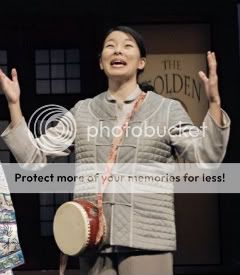
Photo: Sara Ochs in Mu's production of Flower Drum Song, (c) Michal Daniel 2009

Monday, November 8, 2010

Behind-the-Scenes: Cowboy Versus Samurai

In Mu's latest video on our YouTube channel, you will find interviews with some of the cast and hear them talk about working together on such a fun play as Michael Golamco's Cowboy Versus Samurai. You will also hear Sun Mee Chomet bring up one of the more poignant topics of the play: the role of race in romantic relationships.


On Wednesday, November 17th following the evening's performance of Cowboy Versus Samurai, we will be holding a special discussion about the realities and challenges of inter-racial versus intra-racial relationships. The discussion will feature a panel of actors and special guests, and you! Hear from the experts and have your say next week at the Guthrie's Dowling Studio.

Wednesday, October 20, 2010

A weekend in the life of Rick Shiomi

One of the advantages of being the Artistic Director of Mu Performing Arts is traveling and sharing the experience of Asian American theater in other artistic communities. My latest three-day trip to California was a whirlwind of shows, workshops, and meetings that proved how vibrant Asian American theater is in that part of the country.

The first event was a Stories Program workshop sponsored by the Koreatown Immigrant Workers Alliance. It was a small gathering, but with the assistance of LA-based actor Ryun Yu, I was able to run the workshop based upon the stories of the participants. It was a powerful experience, revealing very deeply emotional stories about their own lives. We finished up the workshop the next morning with Ryun directing a short presentation of one of the stories.

Then I was off to San Diego to see a production of David Henry Hwang's Yellow Face (a show that Mu produced last season) by Mo'olelo Theater. The artistic director, Seema Sueko, directed the production and though it was still a preview, I was very impressed by both her creative direction and the cast of the show. The lead, David Henry Hwang's alter-ego DHH, was played by Greg Watanabe. I know Greg from back in the 1990s when he was starting out in San Francisco as a member of the comedy troupe 18 Mighty Mountain Warriors (check out the terrific documentary on the group), so it was especially fun to see him in action again. The audience gave the performance a standing ovation and I knew they had a hit on their hands.

(On a side note, one other fun moment at Mo'olelo involved seeing an image of our own Eric Sumangil from his performance in their 2007 production of Cowboy Versus Samurai, which also happens to be Mu's next production. It's thrilling to see how Mu actors are making names for themselves around the country!)

On that same day, I met with Lauren Yee, the playwright for Ching Chong Chinaman and for a new commission by Mu (stay tuned!), Native Voices artistic director Randy Reinholz, Mo'olelo's Seema Sueko, and Greg Watanabe. It was a jam-packed day!

But there was still more to do. The next morning, I met with Farrell and Sandra Foreman of the new Bear Arts Foundation, which sponsored Colorfest, a multicultural theater festival and conference this past summer. They are trying to set up a new service network for theaters of color, with which Mu would be intimately involved. It's an exciting prospect that will be an invaluable way for our theaters to connect with one another.

After that meeting, I got back in the car and drove back to LA, where I'd started my trip, to do a video interview of Michael Golamco, the playwright for Cowboy Versus Samurai. It's a part of a series of behind-the-scenes interviews and footage that will be featured on Mu's YouTube channel, and is a great way for audiences to get extra insight into the show that they might not get just from their playbill.

My trip ended with the final performance of Mysterious Skin by Prince Gomolvilas at one of the country's largest Asian American theater companies, East West Players. It was quite a terrific performance. After the show the whole cast and crew gathered for their post-show reception and I had an extended discussion with Tim Dang, the artistic director at EWP. After all that, it was off to the airport to catch the red eye flight back home to Minneapolis.

All in a weekend's work.

by Rick Shiomi