
Mu will soon be opening Little Shop of Horrors, a classic American musical loosely based on the 1960 film. Clearly, it’s a popular, beloved, iconic musical complete with cranky Jewish shopkeeper, blonde bombshell, nebbishy hero with a heart of gold, and trio of African-American women paying homage to the girl groups of the 1960s.
And now a bunch of Asian-Americans are producing it. Perhaps it will be weird at first to some people. Some may continue to think it’s weird even after seeing the show. (You are coming to see the show, right? Excellent!) However, I feel that if we do our job well, it won’t seem weird at all.
Let me backtrack for a moment. My name is Sara. I’m a Korean-American adoptee who spent the majority of the last five years living in Seoul, South Korea. It was a fascinating experience on many levels. One of the more intriguing was that for the first time in my life, I felt what it is like to be part of a racial majority. It ROCKED. I wish minorities of any kind could step into the shoes of their opposing majority and truly experience life from that point of view, and the same for majorities of any kind. It does really cool things to your perspective.
As a result, for me, having an all-Asian cast performing a classic from the American musical cannon seems. . . normal. The productions I saw in Seoul usually had an all-Asian cast. I saw all-Asian casts of Puccini's Madame Butterfly (fascinating!), Billy Elliot, an amazing adaptation of Macbeth, and a rehearsal of Rebecca Gilman’s Dollhouse.
Musical theater especially has been hugely popular in South Korea over the last five years. There are currently all-Asian productions of Billy Elliot, Aida, and Monte Cristo, among many others, playing throughout the city. Hedwig and the Angry Inch has been so popular since its debut in Korea in 2005 that nearly every famous Korean musical actor or rock star has played the title role.
I am by no means an expert on Korean society or non-traditional casting practices around the world, but I have the impression that to the average South Korean, it's not weird to see another South Korean playing a character of Caucasian or other ethnicity in a show. From my experience, attempts to justify the casting of all-Asians in a Western production by changing the setting, for example, typically aren’t made. It’s usually all Asians, all the time; that’s just the norm.
For me, seeing Asians playing Caucasian, African, or mixed-race Americans or Europeans was fascinating for a few moments, but if the performances were done well, I soon got lost in the world of the play. Afterwards, I would sit down with friends and discuss the show. What was amazing? What was distracting? Who was drool-inducingly hot? How did the casting affect our experience? There are Caucasian and other non-Asian actors in Seoul, so why weren’t they cast?
South Korea is much different from our American standards of racial sensitivity. It’s true that the country doesn’t have the history, context, or experience to understand how offensive certain actions, such as blackface, are to other cultures. With these considerations in mind, the decision of a South Korean director to use non-traditional casting is, clearly, much different from that of an American director making a similar choice. Perhaps race is simply a non-issue during the casting process. I don’t know.
What I do know, as I slowly sort through everything I’ve learned from life overseas, is that the United States is an incredibly unique country. We Americans have such a complex history of racial, gender, and sexual struggles for equality and independence that we have the opportunity – the luxury, even – to speak with a shared vocabulary. Our uniquely American need to define and categorize our identities causes discussions to occur, theoretically leading to in-depth conversations about race and identity where everyone has the potential to learn and understand.
Sadly, this should be neither amazing nor unique in the world, but at least in my experience, it is. I often attempted to explain why blackface was racist or tried to define racism with my friends and students in South Korea, only to meet puzzled, polite faces. Much of this was due, of course, to our lack of shared language skills. I have acquaintances from Europe who have to converse about race in English, their second or third or even fourth language, because their first language doesn't have a vocabulary to talk about racial issues. Can you imagine that? It’s lead to a lot of heartache for many European Korean-adoptees, but that’s a topic for another time.
Will it be weird for you, our most excellent audience, to see an all-Asian cast performing Little Shop of Horrors? Initially, perhaps it will. However, hopefully as you fall into the world of this fabulous show, you’ll forget that you’re seeing Asian-Americans. You’ll see the characters in all of their quirky, beautiful lives. You’ll laugh and cry and have an all-around great time with our immensely talented Asian and Caucasian American cast, crew, and creative team. And afterwards, perhaps you’ll reflect on the experience and think a little differently about this incredible, one-of-a-kind, racially diverse country we all share.
And if that happens, then I, personally, will feel we’ve done our job well.
by Sara Ochs
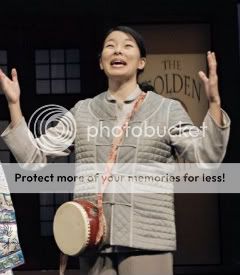
Photo: Sara Ochs in Mu's production of Flower Drum Song, (c) Michal Daniel 2009
